Choosing between IPL and laser hair removal is not just a matter of device names. The American Society of Plastic Surgeons’ 2023 Procedural Statistics Report tracks laser hair removal among minimally invasive procedures, offering a useful snapshot of professional practice. It does not compare IPL and laser outcomes directly. That gap matters.
So, what is the difference between ipl and laser? IPL uses filtered, broad-spectrum pulses of light; laser devices deliver a narrower wavelength range. Both aim to heat pigment in hair follicles, but their light delivery and treatment settings differ. A clinical review by Haedersdal and Wulf in the Journal of the European Academy of Dermatology and Venereology examined evidence for light-based hair removal and highlighted variation among devices and studies. The practical takeaway is modest: results depend on the device, hair characteristics, skin tone, and treatment protocol—not the label alone.
A dark hair on a lighter area of skin may respond differently from fine, pale hair. The sensation can also vary: some people describe quick snaps, while others notice warmth or redness afterward. Small details matter. IPL is not automatically weaker, and laser is not automatically the better choice for everyone. Device names can be confusing, and published comparisons do not always reflect every modern platform. A qualified provider can assess skin and hair, explain realistic outcomes, and discuss possible side effects before treatment. That conversation is part of choosing well.
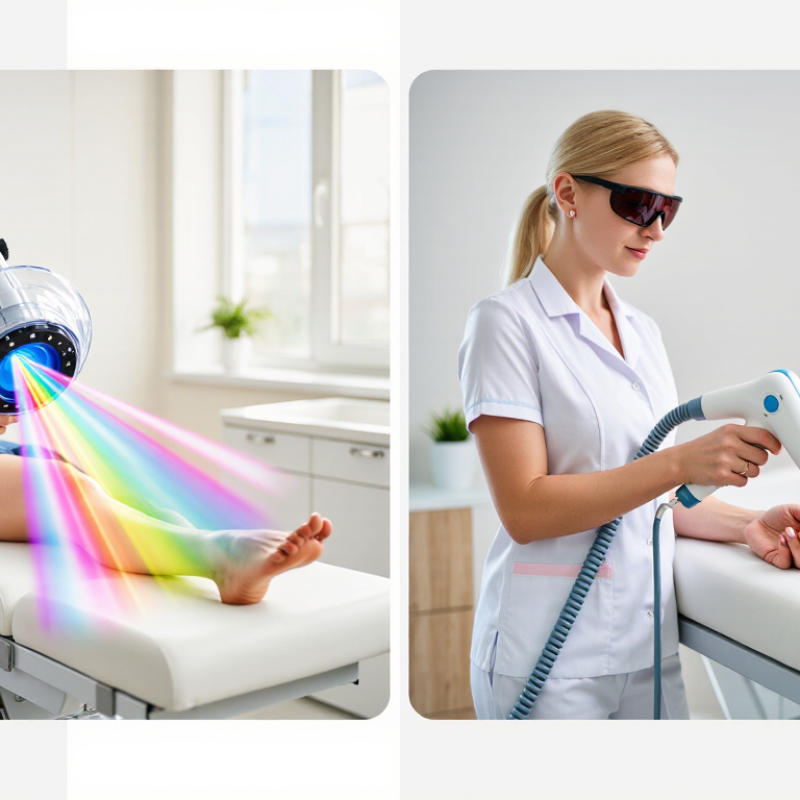
IPL and laser treatments both heat pigment in hair follicles, but their light is different. IPL sends a broad spectrum of filtered light, like a camera flash spread across a patch of skin. A laser delivers energy at a narrow, specific wavelength. That difference affects how selectively energy reaches the follicle. It does not make one method automatically better.
A 2006 evidence-based review by dermatologists Haedersdal and Wulf found that results varied across light-based hair-removal studies and treatment methods. In practice, device settings, hair color, skin tone, and treatment area all matter. Dark, coarse hairs often respond more readily because they contain more pigment; pale hairs may respond poorly. That distinction matters. The American Academy of Dermatology says patients typically need two to six laser treatments, with repeat sessions often needed as new hairs enter a growth phase. This figure is a useful benchmark, not a promise for every person or for IPL. A practitioner should assess skin and hair characteristics before choosing settings, and explain likely results and risks. Even careful treatment can leave patchy regrowth. That is easy to overlook.
IPL and laser hair removal differ most clearly in the light they deliver. An IPL device emits a broad band of light. A 500 nm filter usually blocks shorter wavelengths, while longer wavelengths pass through. That output is not one precise wavelength. Hair pigment absorbs some of this light, but skin pigment can absorb it too. Lasers use narrower, more specific wavelengths, commonly 755, 810, or 1064 nm. The numbers look decisive. They aren’t.
At 755 nm, melanin absorbs strongly, which can help target dark hair but may increase epidermal heating in darker skin. An 810 nm wavelength is widely used for hair follicles, while 1064 nm generally penetrates deeper and is less absorbed by surface melanin. Neither is automatically safer or better. Settings, cooling, skin tone, hair color, and operator training all affect the result. Wavelength alone cannot predict comfort or lasting hair reduction. Treatment plans often need several visits because follicles grow in cycles. Even so, devices and individual responses vary; a careful skin assessment matters more than a number on a screen.
IPL uses filtered broadband light, while hair-removal lasers emit light at a specific wavelength.
The 500 nm value represents a typical IPL filter’s lower cutoff, not a single IPL wavelength. IPL delivers a broad band of filtered light; laser devices emit a specific wavelength, commonly 755, 810, or 1064 nm.
IPL and laser hair removal both rely on melanin absorbing light, but they deliver energy differently. IPL emits a broad range of wavelengths, narrowed by filters. A laser concentrates energy within a more specific wavelength range. That distinction affects how selectively heat reaches the hair follicle and surrounding skin. Darker skin contains more epidermal melanin, which can absorb treatment energy and raise the risk of burns or pigment changes. Hair with strong pigment usually responds better; white, gray, or very light hair may respond poorly. Small details matter.
The Fitzpatrick I–VI scale describes how skin tends to react to ultraviolet exposure, including burning and tanning. It helps guide treatment choices, but it is not a direct measurement of skin color or melanin. The scale can feel blunt: two people with the same rating may have different complexions, tanning histories, and sensitivity. A careful assessment should include the treatment area, recent sun exposure, medications, and past reactions. A fresh tan can change risk, even when a person’s usual classification seems straightforward.
Qualified practitioners may choose different wavelengths, settings, or devices according to skin and hair characteristics. They should explain expected benefits and risks before treatment. A small test area can help assess the skin’s response, though it cannot guarantee how every session will go. The Fitzpatrick rating is one useful clue, not the whole assessment.
IPL and laser hair removal use light, but they are not the same treatment. IPL delivers a broad range of light wavelengths; laser devices target hair with a narrower wavelength. Both work best when hairs are in an active growth phase, so one appointment cannot treat every hair at once. Timing matters. A clinician may recommend about 6–8 sessions, spaced 4–8 weeks apart, but the interval can vary by treatment area, hair growth, and device. Facial hair may need a different schedule from leg hair.
The American Academy of Dermatology’s guidance says many patients need 2–6 laser treatments, commonly about 4–6 weeks apart. That differs from the often-quoted 6–8-session plan; neither range guarantees a result. Ask the practitioner to explain why their proposed schedule fits your skin and hair, and how they will assess progress. A small patch of regrowth between visits is normal. It is also a useful reminder that treatment plans are estimates, not promises. Sun exposure, hormonal changes, and hair color can affect results, so follow the clinic’s preparation and aftercare instructions.
IPL and laser hair removal use different light sources. IPL delivers a filtered band of light, while a laser uses a narrower wavelength range. Skin tone, hair color, treatment area, and device settings affect suitability. A supplier’s comparison chart cannot replace an assessment by a qualified practitioner.
For China, check the exact device name and model against official NMPA records, where applicable. Match the record to the nameplate, manufacturer, and stated intended use. A similar model number is not enough. Check the registration or filing status, too. Keep them separate. If the documents show a different model or use, pause and ask for clarification before purchase.
IEC 60601 refers to a family of electrical-safety and performance standards for medical electrical equipment. Ask for the relevant test report or certificate, and confirm its scope covers the exact model and configuration. Check which standards and editions were used, and whether electromagnetic compatibility was assessed. A logo on a brochure is weak evidence. Inspect the physical label, power rating, warnings, and supplied instructions. Check the model. These checks reduce uncertainty, but they do not prove treatment quality or guarantee safe outcomes. Documents can look convincing; that is exactly why they deserve careful review.
| Comparison Dimension | IPL Hair Removal | Laser Hair Removal | Practical Device Check |
|---|---|---|---|
| Light source | Uses intense pulsed light: filtered, broad-spectrum, non-coherent light delivered in pulses. | Uses laser light at a specific wavelength or a defined set of wavelengths; laser output is generally more spectrally concentrated. | Confirm the device’s stated light source and specifications in its instructions for use and technical documents. |
| How hair is targeted | Light absorbed by hair pigment is converted to heat, which can damage structures involved in hair growth. | Light at the selected wavelength is absorbed by hair pigment and converted to heat to damage hair-growth structures. | Check that intended use, treatment area, and operating instructions match the product’s registered documentation where applicable. |
| Wavelength selection | Filters select a range of wavelengths from the device’s broader output. The available range depends on the device. | The wavelength depends on the laser type; different wavelengths interact differently with melanin and skin. | Review the specified wavelength or filter range, pulse settings, and skin-type guidance; do not infer performance from the term “IPL” or “laser” alone. |
| Potential suitability | Suitability depends on the device, filter, settings, hair and skin characteristics, and operator assessment. | Suitability depends on the laser wavelength and settings, skin and hair characteristics, and operator assessment. | Request the manufacturer’s contraindications and skin-type guidance. A qualified practitioner should assess suitability, especially for darker or recently tanned skin. |
| Hair and skin considerations | Both IPL and laser generally work best when there is sufficient contrast between pigmented hair and surrounding skin. Blonde, white, grey, and red hair may respond poorly. | Hair-removal response also depends on hair pigment and contrast; results vary by wavelength, settings, and individual characteristics. | Check that marketing claims do not promise identical results for every hair colour, skin tone, or treatment area. |
| Number and timing of sessions | Multiple treatments are usually needed because hair grows in cycles. The number and interval vary by person and device. | Multiple treatments are usually needed for the same hair-cycle reason. The number and interval vary by person and device. | Use the treatment schedule in the device instructions or a practitioner’s plan; avoid relying on a universal session count. |
| Expected outcome | Can provide long-term hair reduction after a course of treatments; complete or permanent removal is not guaranteed. | Can provide long-term hair reduction after a course of treatments; maintenance may be needed, and outcomes vary. | Check that descriptions distinguish hair reduction from guaranteed permanent removal. |
| Possible risks | Possible effects include temporary redness or discomfort; burns, blistering, pigment changes, or eye injury can occur, particularly with unsuitable settings or inadequate protection. | Possible effects include temporary redness or discomfort; burns, blistering, pigment changes, or eye injury can occur, particularly with unsuitable settings or inadequate protection. | Review warnings, operator training requirements, cooling guidance, and eye-protection instructions. Follow the device-specific safety documentation. |
| China NMPA status | Regulatory status depends on the product’s intended use, classification, and applicable Chinese requirements; do not assume every IPL product has the same status. | Regulatory status depends on the product’s intended use, classification, and applicable Chinese requirements; do not assume every laser product has the same status. | Search the official NMPA device database where relevant. Match the registration or filing details to the exact product, model, intended use, registrant, and validity period. Ask the supplier for the relevant documentation and verify it independently. |
| IEC 60601 safety checks | IEC 60601-1 addresses general basic safety and essential performance for applicable medical electrical equipment; IEC 60601-1-2 addresses electromagnetic compatibility. IEC 60601-2-57 may be relevant to non-laser light-source equipment for cosmetic/aesthetic use, depending on scope and applicability. | IEC 60601-1 and IEC 60601-1-2 may apply; IEC 60601-2-22 covers particular requirements for applicable laser equipment used for surgical, cosmetic, therapeutic, or diagnostic purposes. | Request test reports or certificates and check the exact model, standard number and edition, test scope, issuing laboratory, and report validity. Applicability depends on the device and market; a claimed standard alone is not proof of NMPA approval. |
Important: IPL and laser devices are not interchangeable, and neither technology is automatically safer or more effective for every person. This table is general information, not medical or regulatory advice. Confirm current Chinese requirements with the relevant authority and have treatment suitability assessed by a qualified professional.
A plan may include 6–8 sessions, spaced 4–8 weeks apart. Some guidance describes 2–6 laser treatments. Still, estimates are estimates.
Light treatments work best when hairs are in an active growth phase. Not every hair reaches that phase at once.
No. Facial hair may need a different schedule from leg hair. Hair growth and device settings also matter.
No. IPL uses a broader range of light wavelengths. Laser devices use a narrower wavelength range.
Skin tone, hair color, treatment area, and settings can affect suitability. Sun exposure and hormonal changes may also influence results.
Yes, a small patch of regrowth can happen. It can help show that the plan is not a promise.
Match the exact model, manufacturer, and intended use against official records where applicable. Check the registration or filing status, too. Similar names are not enough.
Ask for a relevant test report or certificate covering the exact model and configuration. Check the standards, editions, and electromagnetic compatibility scope. A brochure logo proves little.
Understanding what is the difference between ipl and laser starts with how each device delivers light. IPL uses broad-spectrum light filtered to selected wavelengths, often starting around 500 nm, while laser systems concentrate energy into a single wavelength, commonly 755, 810, or 1064 nm. Both approaches target melanin in the hair, but suitability depends on hair and skin characteristics. A careful assessment using the Fitzpatrick I–VI scale helps a qualified provider consider skin tone, treatment settings, and potential risks.
Hair removal usually requires a series of treatments because hair grows in cycles. A common plan involves 6–8 sessions, spaced about 4–8 weeks apart, with individual needs varying. When comparing devices in China, check their NMPA status and confirm relevant IEC 60601 electrical-safety compliance. These checks, along with professional assessment and appropriate treatment settings, can help support a more informed choice between IPL and laser.
